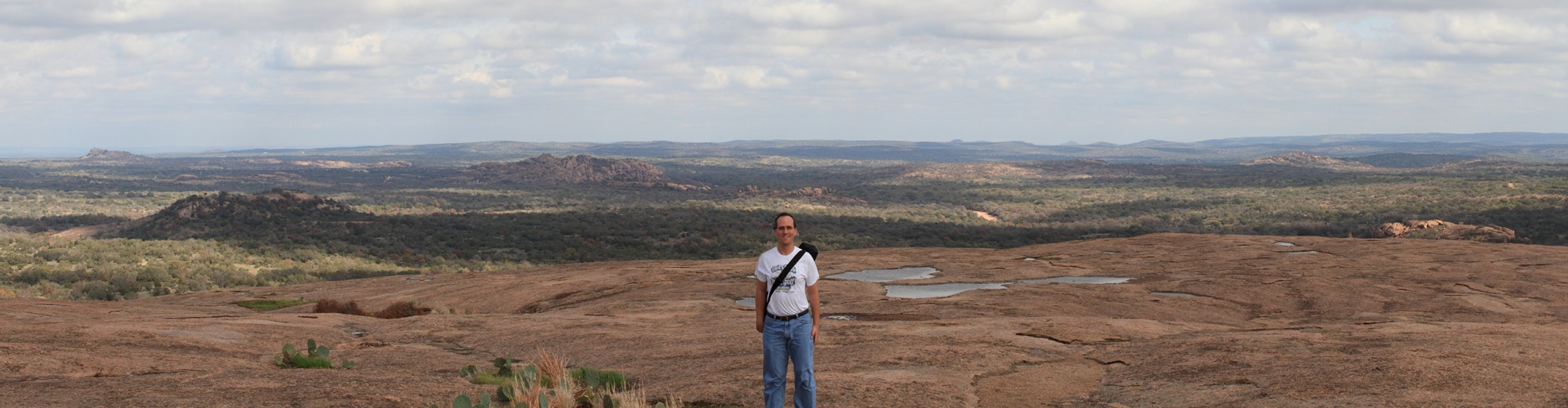
How, odd. That is not what I expect from this neighborhood…
Disc Golf 12/08/2007

John created another meetup group for disc golf. I guess that the RRGDG group fell apart for him. This has some pros and cons. The pros are I know everyone in RRGDG and they are all good disc golfers. The cons are this meetup group has a lot of people who only come one time or they are very new to disc golf.
Today, we had Robin who is new to disc golf and a dam inspector (and coincidently, news8austin is running an expose on the state of our dams) and Tony who has been playing disc golf for a while and prefers to run the course while playing.
Afterwards, we went to Chuy’s for lunch.
Game Day 12/07/2007

Tonight was another 1st week in a month with The Central Texas Boardgames Meetup Group. We started out with a couple of hands of Escalation!. Next up was a Wallace game that I wanted to try out — a reprint of one of his older games called Mordred. It certainly looked interesting. The rules were simple. They even promised that the game would play quickly. And with one of three possible ending conditions, it looked likely. However. And this is a big however. Our game was the complete opposite of quick. It must have dragged on for hours. Not all of it was the game’s fault. Rules explainers were dragged off. People took breaks to get munchies. And the players were far too conservative. But I will give this game another chance…
Disc Golf 12/07/2007

John and I played at the Old Settler’s Park Winter course. But we didn’t have enough time to finish it. First Friday Fluff was on later tonight and John had to leave early to prepare.
Game Day 12/06/2007

Jon held game day at his house this time. And all of the games that we played came from John’s “box of fluff.” But these weren’t fluffy. So there’s hope for John after all.
First up was Cuba. This time I went for “the blue strategy.” I was second to start and I was worried that someone else would take my building. So my first action was to build the Dam. Jon apparently was going to go for that one as well (I learned this after the game). Instead, he took the Hotel (2 victory point generator). I wasn’t worried that someone would take the Golf Course (convert water into victory points). So I took the Inn. And, on the next turn, I built the Golf Course. On the third turn, both the Duty Act and the Subsidy Act were the water ones. Clearly, I needed to win that vote. But I made the mistake of not spending all of my money (I decided to keep a couple of bucks). Jon did the team thing and stopped me from winning the vote. This took me out of a first place win. Instead, I ended up second.
I don’t know about the water (or blue) strategy. I did not produce that many goods. And, consequently, I didn’t ship that many (or fulfill the Duty Act) either. The four water resources and one victory point gave me a constant increase of 5 victory points a turn. Which is not bad. But the rum or cigar cafes will allow you to get a maximum of 6 victory points per turn. While the red, white, or blue cube converters only allow a maximum of 4.

Next up was Gipsy King. Which I missed playing at BGG.con. This is a lighter but still meaty game. And its a perfect one for lunch. I view it as a purely abstract game. In fact, I don’t even know what the “theme” is. I suspect that it may involve Gypsies. But I could be wrong.
This is a block placement game where you are trying to get long chains of your blocks. The longer the better. And, secondarily, you also try and get majority control of lakes with fishes. If you control a lake, you get a number of victory points that equal the amount of fishes in it (small numbers). Ties are good. Everyone shares the points equally. The real big amounts of victory points come from the length of your chain. You score triangle points based on the length.
There are two round in the game. You start surrounding lake number one and continue until the highest lake is surrounded. On the next round, you start at the highest number and move down to one. You can either place one of your blocks on a hex surround the lake in question. Or, you can pass and enter the queue for placement at the next lake. This is sometimes a good thing indeed, as you are trying to connect your chains. And you will skip areas to concentrate on others.
We ended the night with a game of Tichu…
| GT/T | Team #1 | GT/T | GT/T | Team #2 | GT/T |
|---|---|---|---|---|---|
| MarkH & Jon | JohnG & DougG | ||||
| 120 | T+ |
80
|
|||
| 145 | T+ |
255
|
|||
| T+ |
325
|
275 | |||
|
405
|
395 | T+ | |||
|
495
|
405 | ||||
| 510 |
390
|
T- | |||
| 810 | T+ | 390 | |||
| 1110 | T+ | 390 |
…scored on a cute pad of paper!

My first computer

This thread on BGG got me motivated to get my old computer out of the closet and take a picture of it.
My what progress we have made… Have 101 programming tips & tricks books been around that long?
Dyson Malibou light

There was quite a surprise when I opened my malibou light to replace a burned out light bulb. I found a whole ecology inside! Of course, there was light and air, but also flora, predators and prey. My last surprise inside a Malibou light was an ant farm. It was filled to the brim with dirt… and ants.
No-Knead Bread 2.0
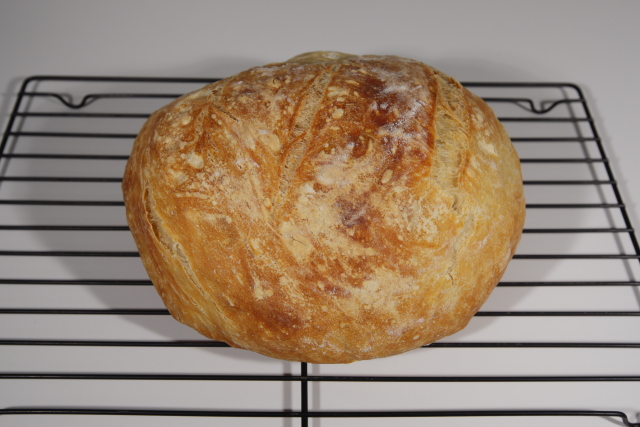
I received the latest Cook’s Illustrated in the mail. And I just had to try out the new bread recipe. While not a true “no-knead” recipe (you do it about 10 to 15 times), it is pretty close. But that was not what was interesting about this recipe. The first unique thing was cooking it in a preheated dutch oven. This created a nice and steamy sauna for the bread to cook in. The other thing was using lager beer (Moosehead in this instance) and white vinegar to simulate sourdough starters.
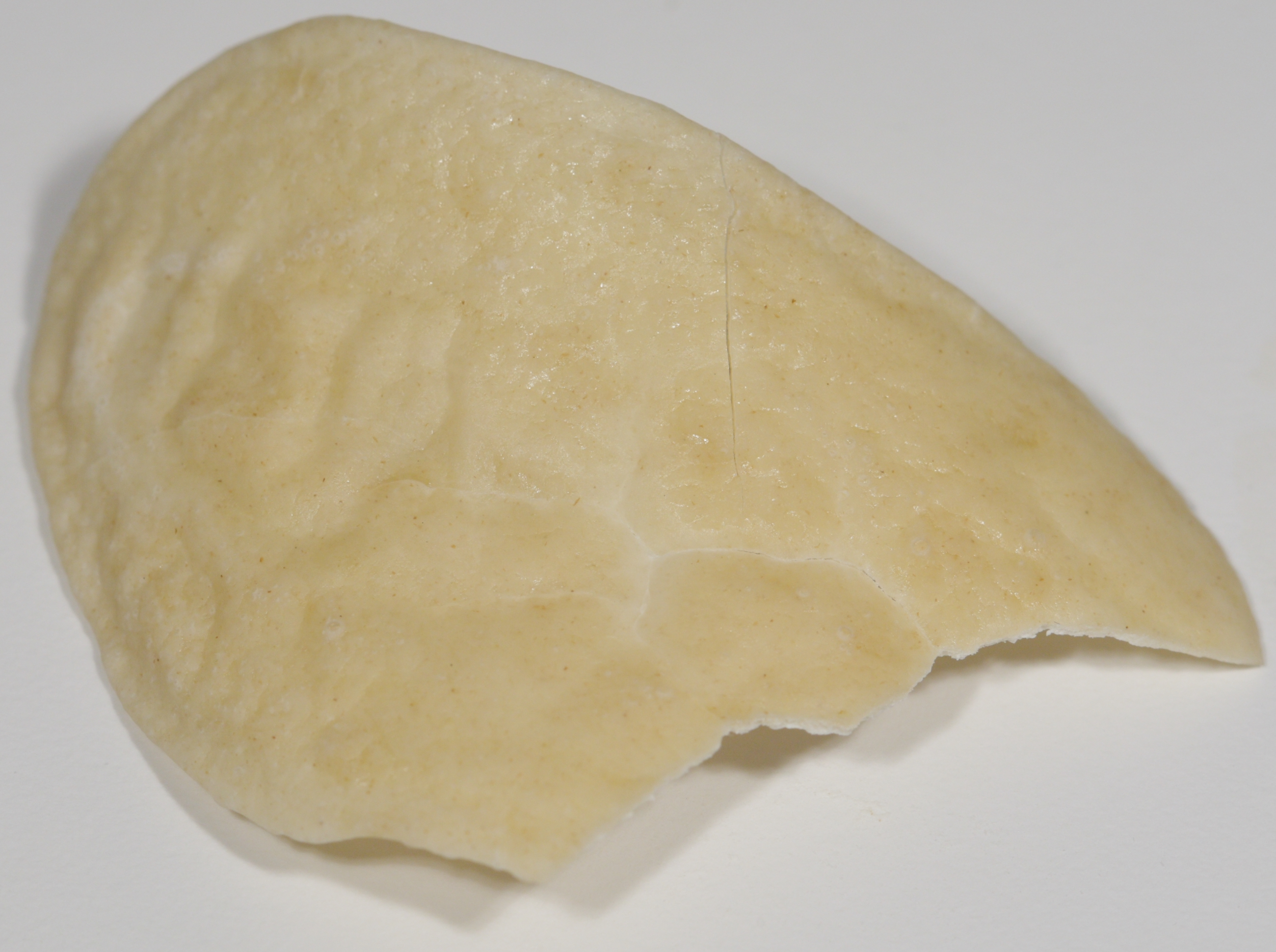
When I went to turn on the oven to 500, I noticed this sourdough chip laying in the dripping pan. My last batch of sourdough starter was overly expansionistic and I forgot about its escapees. Millions of them gave their lives to become this chip.
links
Firefox memory fragmentation link via
The Temperamental Shower link via
Balancing bowls tell you when 100grams of food are inside link via
Your Creation museum report link via
24: The Unaired 1994 Pilot link via
Well Done: a food company annual report that has to be cooked first to be read link via
Christmas ornaments grow from folded paper link via
Encoding the restaurant experience into the bill amount link via
X-Ray of hand after homemade explosive detonates early link via
Will you swim faster in a thicker water? link via
The Great Spiral Galaxy in Andromeda looks bigger than the moon link via
Matt Stuart’s photographs link via
Attractiveness and dating link via
Moonlit panoramic photo of the Hanalei Vally Lookout on the island of Kauai, Hawaii (Canon 5D, 16-35mm f/2.8 at f/2.8, 10.0 second exposures ISO 800 at 16mm) link via

Pop-Up Market in Bangkok link via
Fact checking Dawkins link via
Roasted sweet potatoes
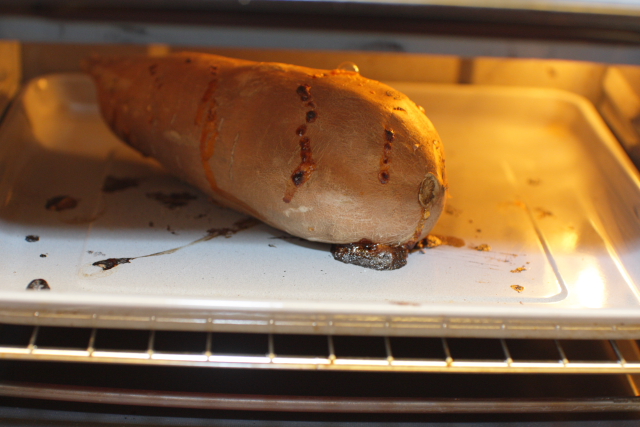
Lately I have been experimenting with sweet potatoes. My current recipe for making them uses two main ingredients: the potatoes themselves and caramel. The first step is to cook the potatoes in an oven. I use my convection toaster oven set to 350 or so and leave them in for an hour… ish. Make sure that you poke holes in the potatoes you really don’t want those suckers to explode in your oven. I’ve had that happen and its not pretty.
While the potatoes are cooking, make the caramel. At its most basic level all it really involves is to toast some sugar and pour some heavy cream in to smooth it out. But there are multiple ways of doing this. I usually do the dry method. Which is to pour sugar into a nonstick skillet and heat it until it liquefies and turns brown. But this method is prone to scorching. Another way is the wet method. Add water to the sugar and boil it until the water evaporates. By then, the sugar will have melted and you can continue boiling until the sugar caramelizes nicely. But this method has a risk of crystals forming. You have to babysit the pan and wet or grease the sides down to discourage crystallization.
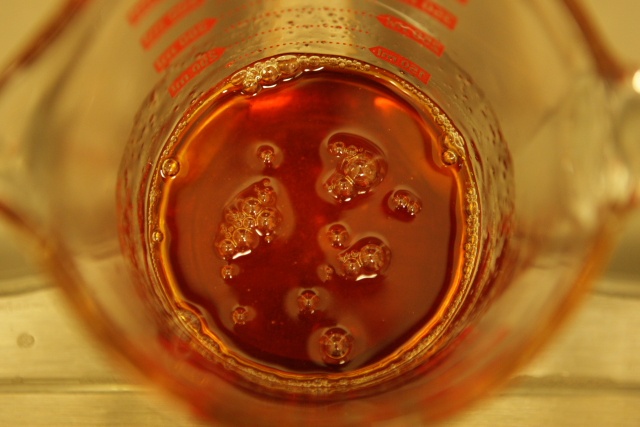
I tried a new method recommended by one of my favorite cookbook authors: Shirley Corriher. This is to use a microwave. To prevent crystals from forming, Corriher explains that the substance must be impure. The impurities that you can add to the caramel come in different forms of sugar. Table sugar is a double sugar which consists of fructose and glucose that are joined together. By adding corn syrup (mostly glucose) and by adding lemon juice (an acid which cuts the sugar into fructose and glucose), you have a mixture of three kinds of sugar. These molecules are different enough to prevent crystallization.
In a microwave safe pyrex bowl, add 1 cup of sugar, 1/2 cup of corn syrup, and 10 drops of lemon juice. Thoroughly mix together (adding a little bit of water if needed). Microwave on high for a couple of minutes until the mixture starts bubbling. Now, closely watch it until it turns light brown. When it does, turn off the microwave! Carryover cooking will continue to brown the mixture. Keep in mind that this liquid sugar is close to 250 degrees Fahrenheit.
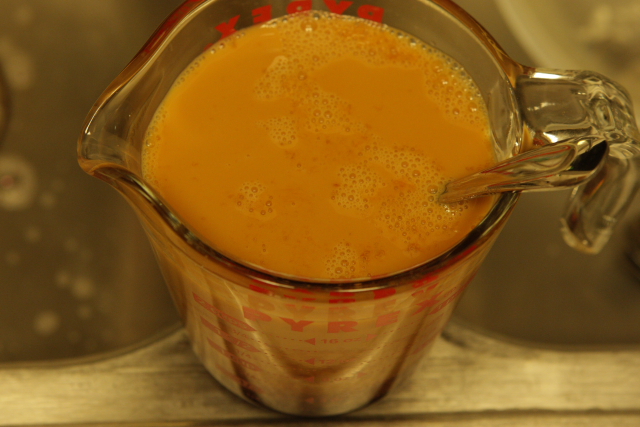
Next add heavy whipping cream. But this time I used evaporated whole milk. This is by far the hardest part. In a saucepan, boil the cream (or evaporated milk). Pour the still molten sugar in and step back. That cream will bubble furiously! And the sugar will instantly harden rock solid. Turn off the heat and stir the mixture. Eventually, if you work hard enough, the sugar will melt back into the liquid. Also be aware that if you use water rather than cream or milk that you are creating an exothermic reaction. The mixture will actually heat up. And another thing to keep in mind, perhaps the most important thing, is that the stages of sugar cooking are rather thin. The firm ball stage of sugar syrup is from 244 to 248 degrees Fahrenheit. Not a very large margin of error.
You can make the caramel ahead of time. And you can let the potatoes cool down for a while. Or even cook them ahead of time as well. All you need to do is to whip up the potatoes and add whatever amount of caramel you want. And if you are A. R. enough, you can strain the sweet potatoes through a food mill to help reduce the stringy fibers. Don’t forget to add salt and pepper while you mix it…
The final result is a medley of roasted notes. The roasted sugars in the potatoes, the roasted sugar in the caramel, and the roasted milk sugars from the evaporated milk.